 Skip to content


Cantonese-style Crispy Potato Cakes All-Day Breakfast
Cantonese cuisine · 30 minutes · Serves 2 to 3
Cantonese Crispy Hash Brown All-Day Breakfast
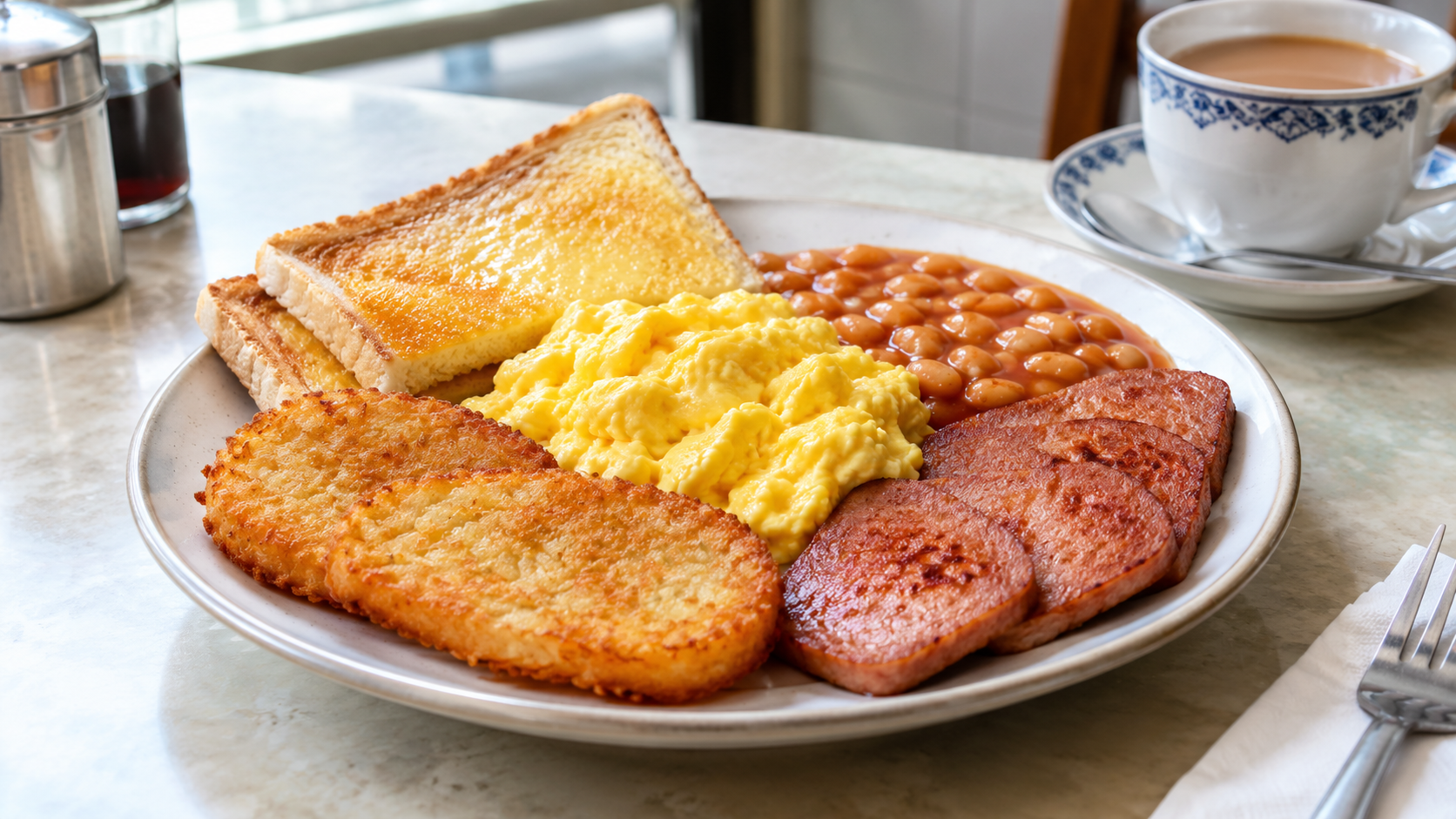
Although hash browns are not a traditional Chinese dim sum, they have long been integrated into the Western breakfast culture of Hong Kong cha chaan tengs and ice rooms. Breakfasts in Hong Kong cha chaan tengs commonly feature combinations of eggs, luncheon meat, sausages, and toast, and many Cantonese-style breakfasts now include hash browns as a side; some restaurants even serve an all-day breakfast consisting of scrambled eggs, hash browns, and other breakfast meats. After researching existing Hong Kong menus and potato recipes, this time we did not force hash browns into a thick-sauce stir-fry, but instead chose an all-day breakfast plate that best suits Hong Kong family breakfast habits. The hash browns provide a crispy exterior and soft interior, the scrambled eggs offer a smooth texture, the luncheon meat adds a salty aroma, and the toast and baked beans complete the familiar taste of a cha chaan teng breakfast. Regarding oil usage, we use air-fried or baked hash browns instead of additional deep-frying, maintaining crispness while being more suitable for daily home preparation.
Quick Answer
These hash browns are best served as a Cantonese cha chaan teng-style all-day breakfast: prepare the hash browns according to the packaging instructions, which indicate heating at approximately 200°C for 12 to 15 minutes, prioritising the product packaging's defrosting requirements; simultaneously pan-fry the luncheon meat, scramble the eggs, and toast the buttered bread, then plate with baked beans. The key is to ensure the hash browns have a golden, dry surface and a hot centre, while the eggs are scrambled until fully set. As different air fryers or ovens vary in heat output, final results should be based on the packaging instructions and actual doneness.
Ingredients
- Frozen hash browns 4 pieces, prepared according to packaging instructions
- Eggs 3
- Luncheon meat 3 slices
- White bread 3 slices
- Baked beans 150g
- Butter 10g
- Fresh milk 1 tablespoon
- Salt 1/8 teaspoon
- Cracked black pepper a little
- Cooking oil 1 teaspoon
Method
-
First prepare the hash browns according to the packaging
First check the hash brown packaging for defrosting and heating requirements; do not assume on your own that defrosting is required or that they can be cooked directly. The packaging diagram indicates heating at approximately 200°C for 12 to 15 minutes; if the product instructions require preheating or specify other equipment, the packaging should be followed. Do not stack the hash browns; leave a small amount of space to allow hot air circulation.
-
Heat the hash browns until golden
Heat at the temperature and time indicated on the packaging, approximately 12 to 15 minutes, until the surface is uniformly golden, the edges are dry and crispy, and the centre is hot. Only flip if the packaging or equipment instructions require flipping midway. If the hash browns are not golden and hot after 15 minutes, add a short period of heating according to the equipment's condition.
-
Prepare cha chaan teng-style scrambled eggs
Mix the eggs with fresh milk, salt, and a little cracked black pepper. Preheat a non-stick pan over medium-low heat, add about half a teaspoon of cooking oil, pour in the egg mixture, and slowly push from the outside in with a spatula. As the egg mixture begins to set, continue stirring for about 2 to 3 minutes until the egg mixture is fully set but still remains soft.
-
Pan-fry the luncheon meat
Add the remaining cooking oil to the same pan and pan-fry the luncheon meat over medium heat for about 1 to 2 minutes per side, until both sides are golden and the edges are slightly crispy. The luncheon meat is already salty, so no additional heavy seasoning is needed.
-
Heat the baked beans
Place the baked beans in a small pot and heat over medium-low heat for about 3 to 4 minutes, stirring occasionally, until steaming hot. Do not cook over high heat for a long time, as this may cause the sauce to reduce excessively.
-
Toast the buttered bread
Toast the white bread in a toaster or oven until the surface is golden, and spread a thin layer of butter while hot. The toast should have a slightly crispy exterior and retain some softness inside, avoiding being toasted too dry.
-
Assemble the Cantonese breakfast plate
Plate the golden hash browns, scrambled eggs, pan-fried luncheon meat, buttered toast, and hot baked beans in separate sections. It is best to place the hash browns on the plate last to prevent them from absorbing moisture from the baked beans and becoming soggy. Eggs should be thoroughly cooked; if using a food thermometer, the centre should reach 75°C. Without a thermometer, ensure the yolk and white are fully set, and consume immediately after preparation.
Frequently Asked Questions
Do frozen hash browns need to be defrosted before cooking?
Do not assume on your own. The defrosting and heating methods for frozen processed foods should follow the packaging instructions first; this product's packaging diagram lists heating information of approximately 200°C for 12 to 15 minutes, but actual preparation should still follow the complete instructions and equipment requirements on the packaging in hand.
What are hash browns usually served with in Hong Kong cha chaan tengs?
Currently, Western breakfasts in Hong Kong cha chaan tengs and ice rooms often serve hash browns on the same plate with scrambled eggs, luncheon meat, sausages, bacon, toast, or baked beans. For example, Hong Kong restaurant menus show combinations of hash browns with scrambled eggs, luncheon meat, or other breakfast meats, so this time we chose luncheon meat, scrambled eggs, toast, and baked beans, which is closer to the direction of local cha chaan teng breakfast plates.
How to make scrambled eggs as tender as in a cha chaan teng breakfast?
After adding a small amount of fresh milk to the egg mixture, slowly push and stir over medium-low heat; do not use high heat at the start to dry out the egg mixture. The pan should be removed from the heat as soon as the egg mixture is just fully set, using residual heat to complete the final cooking. The Centre for Food Safety recommends cooking eggs thoroughly until the centre temperature reaches 75°C or until the yolk is set; therefore, home preparation should not use half-cooked eggs as a safety standard.
Why do hash browns become soggy quickly after coming out of the oven?
Once hash browns come into contact with baked bean sauce or other moisture, the crispy surface will soften relatively quickly, so hash browns should be placed in separate sections from wet accompaniments, and preferably plated last after the hash browns are fully heated. Eating immediately after cooking also results in better texture.