 Skip to content


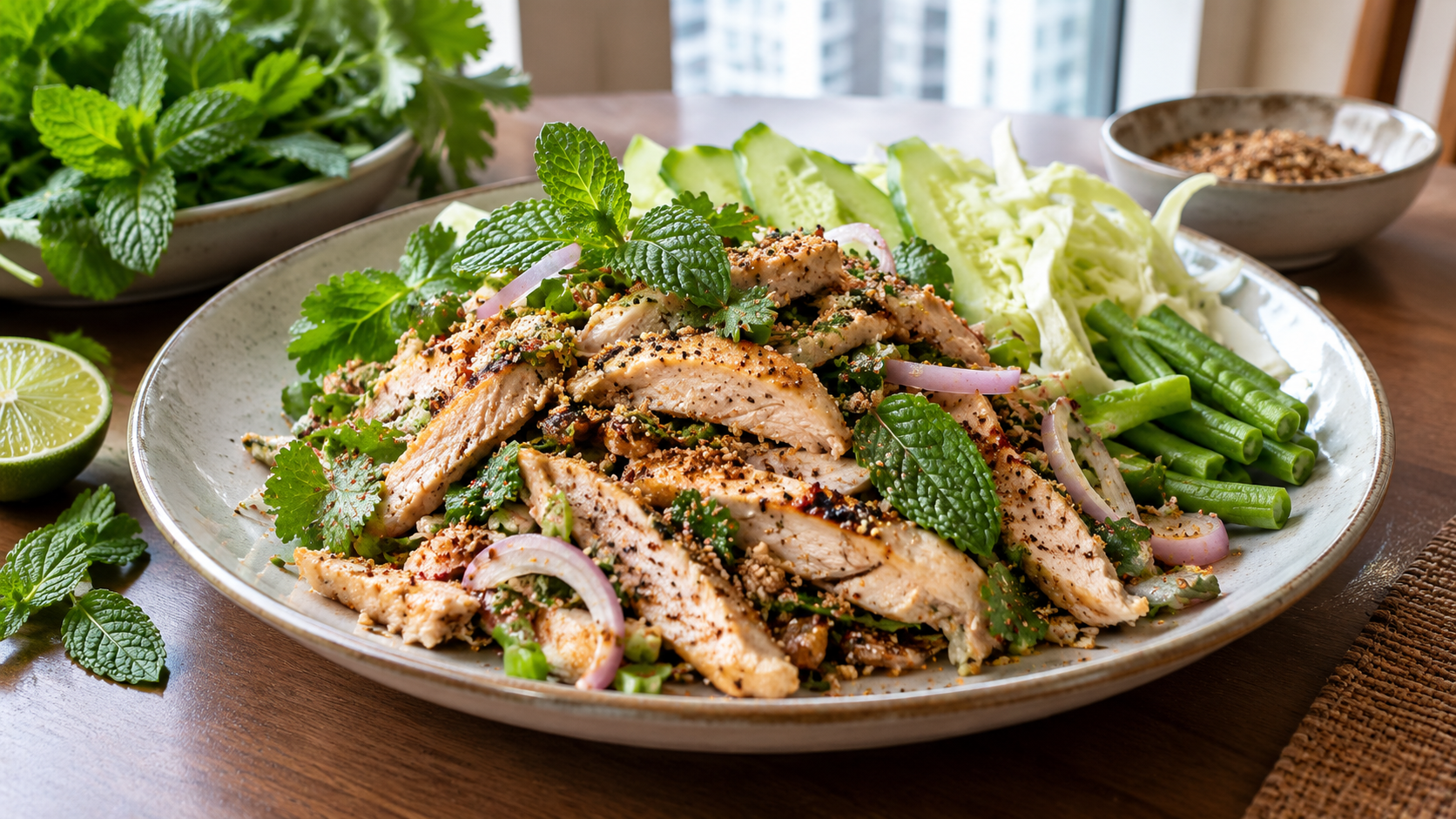
Thai Northeastern Herb Chicken Breast Salad
Thai cuisine · 20 minutes · Serves 2 to 3
Thai Northeastern Herb Chicken Breast Salad
This chicken breast is already seasoned with Moroccan BBQ spices. Rather than coating it in a generic Thai sweet chilli sauce, it is better to borrow the classic technique of Thai Northeastern cuisine to turn it into a chicken salad close to Nam Tok Gai (นํ้าตกไก่). Thai Northeastern cuisine often uses sour, salty, and spicy notes as its framework, paired with sticky rice and fresh herbs; Nam Tok is typically composed of sliced grilled meat, lime juice, fish sauce, chilli, shallots, and toasted rice powder. This approach preserves the original grilled aroma of the chicken breast while using lime, mint, and toasted rice powder to create distinct layers. Considering the palates of Hong Kong families, the amount of chilli is reduced, palm sugar is used only to balance the acidity, and the fish sauce is more restrained than in some traditional recipes to avoid competing with the existing BBQ seasoning.
Quick Answer
First, process the chicken breast according to the packaging instructions: if labelled as ready-to-eat, safely thaw it and then slice; if the packaging requires heating, heat it according to the instructions. Then, pan-fry the chicken breast in a non-stick pan over medium heat for about 1 to 2 minutes per side until the surface is slightly charred. While still warm, toss with lime juice, fish sauce, a small amount of palm sugar, crushed chilli, shallots, mint, coriander, and freshly toasted rice powder to create a Thai Northeastern-style chicken salad with grilled, sour, and herbal notes. If reheating is required, the centre of the chicken should reach 74°C (165°F).
Ingredients
- Cooked chicken breast 500g, thaw or heat according to packaging instructions, then slice
- Sticky rice 15g
- Shallots 40g, thinly sliced
- Fresh mint leaves 15g
- Coriander 10g, roughly chopped
- Spring onions 15g, finely chopped
- Limes 2, juice approx. 30ml
- Fish sauce 15ml
- Palm sugar 5g
- Crushed chilli 1/2 to 1 teaspoon
- Cucumber 100g, sliced
- Cabbage 100g, roughly shredded
- Green beans 80g, cut into segments
- Cooking oil 1 teaspoon
Method
-
Prepare the chicken breast first
Process the chicken breast according to the thawing and heating methods on the packaging; do not assume the product does not need thawing. If the packaging states it is ready-to-eat, you can slice it directly after thawing; if heating is required, complete the specified procedure first. Slice into pieces approximately 0.5 to 1 cm thick; if too thick, the seasoning will not mix evenly.
-
Toast the sticky rice to make rice powder
Without adding oil, place 15g of sticky rice in a dry pan and stir continuously over medium heat for about 4 to 6 minutes. Remove from heat immediately when the grains turn from white to golden yellow and emit a nutty aroma without charring. Once cooled, grind in a mortar or grinder into a coarse powder with a slightly gritty texture; do not grind into a fine powder.
-
Pan-fry the chicken breast for grilled aroma
Add 1 teaspoon of cooking oil to a non-stick pan and preheat over medium heat. Add the chicken breast and fry for about 1 to 2 minutes per side, just until the surface develops charred edges; avoid frying for too long until dry and hard. If the product requires reheating, use a food thermometer to measure the thickest part; it is done when the centre reaches 74°C (165°F).
-
Create the Northeastern flavour
Place lime juice, fish sauce, palm sugar, and crushed chilli in a large bowl and stir until the sugar dissolves. Sugar and chilli are deliberately kept low here because the chicken breast already has BBQ seasoning; the taste should be dominated by sour, salty-umami, and mild spice, rather than sweet chilli sauce flavour.
-
Add shallots and herbs
Add shallots, spring onions, coriander, and half of the mint leaves. Toss gently for about 30 seconds to allow the lime juice to slightly soften the shallots while retaining the freshness of the herbs.
-
Toss in chicken breast and toasted rice powder
Add the chicken breast to the bowl while still slightly warm, and toss gently until the seasoning is even. Then add about 10g of toasted rice powder. The rice powder will absorb the chicken juices and lime-fish sauce mixture while adding a unique toasted aroma; finally, add the remaining mint leaves to prevent the aroma from dissipating too early.
-
Plate the accompaniments
Place cucumber, cabbage, and green beans around the edge of the plate, and place the chicken salad in the centre, sprinkling with a small amount of the remaining toasted rice powder. It should be eaten immediately after completion, while the chicken is still warm, the herbs are crisp, and the sourness is well-rounded; it can also be served with a small amount of sticky rice for a complete meal.
Frequently Asked Questions
Why is this chicken breast suitable for a Thai Northeastern chicken salad?
Because the focus of Nam Tok is not a thick sauce, but sliced grilled meat paired with lime, fish sauce, chilli, shallots, herbs, and toasted rice powder. The cooked chicken breast already has grilled meat seasoning, so it only needs a short time to be pan-fried for aroma, and then these core elements can be added to build the flavour layers of Northeastern cuisine.
What is the difference between Nam Tok and Thai Larb?
Both belong to Thai Northeastern cuisine and use lime, fish sauce, chilli, herbs, and toasted rice powder, but the characteristic of Nam Tok is sliced grilled meat, whereas Larb typically uses minced or ground meat. This time, the chicken breast is kept in whole slices, so it is closer to the direction of Nam Tok.
The chicken breast already has Moroccan BBQ flavour; will it clash with Thai seasoning?
It is possible, so the seasoning ratios should not be copied from heavier-flavoured versions. This version reduces palm sugar and chilli, and the fish sauce is controlled at 15ml, mainly using lime, mint, coriander, and toasted rice powder to increase brightness, allowing the original grilled aroma to be the base flavour rather than being covered by the sauce.
Can it be pan-fried directly from the frozen state?
You should first check the product packaging instructions. If the packaging requires thawing, you should thaw it according to the specified method before frying; do not put unknown packaging directly into the pan. If the product requires reheating, the centre of the chicken should reach 74°C (165°F).