 Skip to content


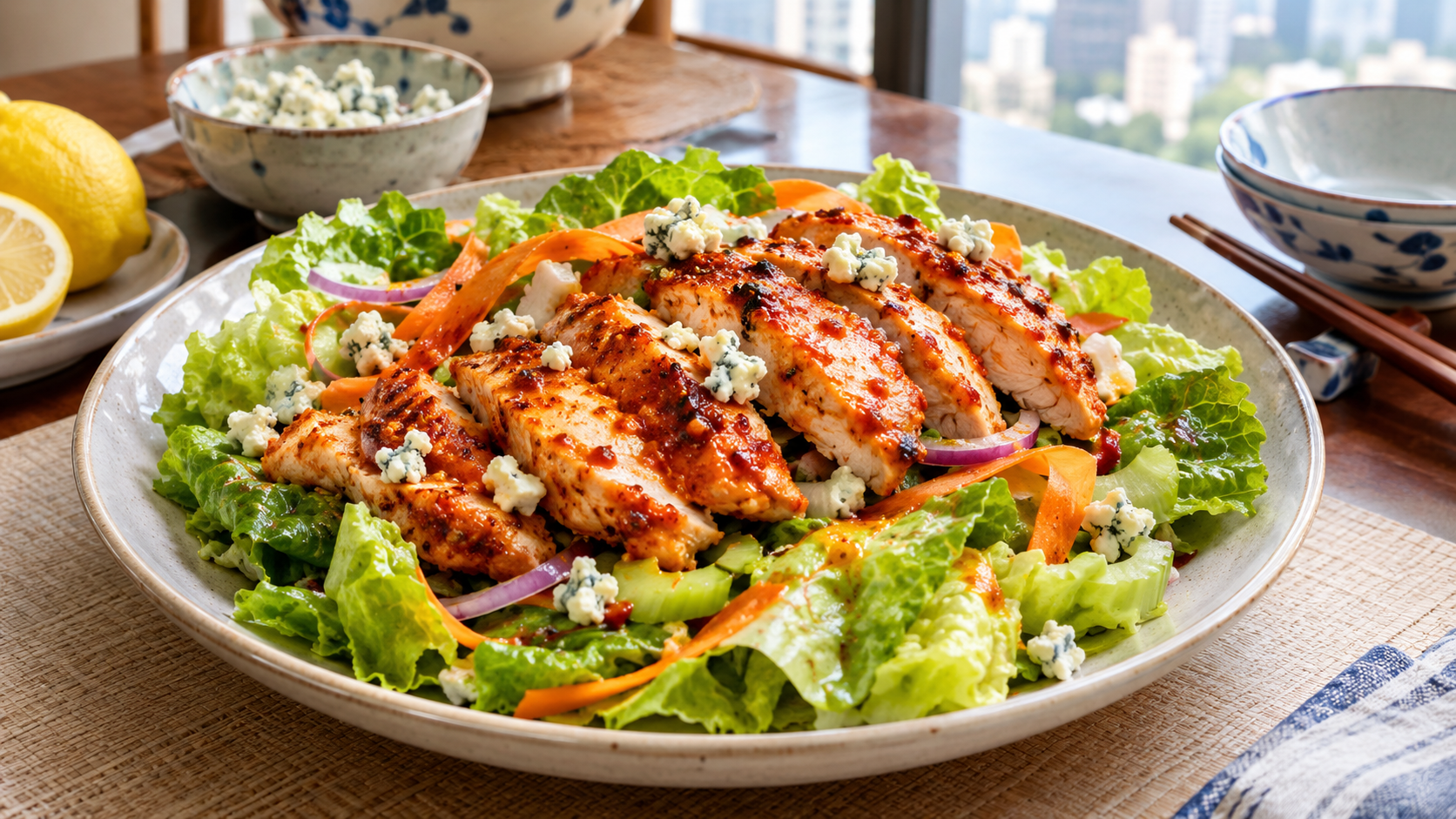
Buffalo Spicy Chicken Breast Crispy Salad
American · 20 minutes · Serves 2 to 3
Buffalo Spicy Chicken Breast Crisp Salad
The core of Buffalo chicken is not simply 'adding hot sauce', but a combination of spiciness, sour aroma, and butter, paired with celery and blue cheese to create a distinct contrast. Traditional Buffalo wings originate from Buffalo, New York, USA, where the classic way to eat them is chicken wings tossed in hot sauce, served with celery and blue cheese dressing; this flavour profile has since been widely extended to chicken breast and salads. This time, ready-made Korean-style spicy cooked chicken breast is used to replace fried chicken wings, retaining the sour-spicy butter framework of the Buffalo flavour while reducing the deep-frying step, making it more suitable for quick family meals in Hong Kong.
Quick Answer
This product itself is cooked Korean-style spicy chicken breast; first defrost and heat according to the packaging instructions. If it is labelled as ready-to-eat, it can be sliced directly. To make it into an American Buffalo style, you can use a small amount of butter and white vinegar to adjust the original hot sauce into a sour, smooth thin sauce, then pair it with celery, blue cheese, and crisp lettuce, and finally slice the chicken breast and lay it on top. If the packaging does not clearly specify the heating method, it is safer to reheat and measure the centre with a food thermometer to reach 74°C.
Ingredients
- Cooked chicken breast 500g
- Romaine lettuce 1 head, cut into coarse shreds
- Celery 2 stalks, cut into thin diagonal slices
- Carrot 1/2 piece, cut into fine shreds
- Red onion 1/4 piece, cut into thin slices
- Blue cheese 40g, crumbled
- Unsalted butter 20g
- White vinegar 1 tablespoon
- Lemon juice 1 teaspoon
- Garlic powder 1/4 teaspoon
- Black pepper a pinch
- Olive oil 1 teaspoon
Method
-
1. Prepare the chicken breast first
First check the defrosting and heating methods on the packaging and follow them; if defrosting is required, place it in the refrigerator to defrost slowly, do not leave it at room temperature. If the product is labelled as ready-to-eat, you can proceed directly to the next step; if it needs reheating, heat it according to the packaging requirements. If the packaging does not have clear safe heating instructions, it is recommended to heat the centre to 74°C using a food thermometer.
-
2. Make the Buffalo-style thin sauce
In a small pan over medium-low heat, add unsalted butter, melt for about 1 minute then turn off the heat, and stir in white vinegar, lemon juice, and garlic powder. White vinegar provides the acidity required for the traditional Buffalo flavour profile, while butter makes the spiciness of the original Korean-style hot sauce smoother.
-
3. Let the chicken breast absorb the sour-spicy butter aroma
Slice the chicken breast into diagonal slices about 1cm thick. If the chicken breast has already been heated according to the packaging, place it in the pan which is still warm, add about half of the butter-vinegar sauce, and gently toss for 30 to 60 seconds; just ensure the surface is evenly coated with sauce, do not cook for a long time to avoid the cooked chicken breast becoming dry.
-
4. Make the crisp vegetable base
Place romaine lettuce, celery, carrot, and red onion in a large bowl, add olive oil, a pinch of black pepper, and half of the remaining butter-vinegar sauce, toss until the vegetable surface is thinly coated with sauce. Celery should remain crisp, do not pre-cook it until soft.
-
5. Assemble the salad
Spread the vegetables on a large plate, neatly place the warm chicken breast slices on top, then sprinkle with blue cheese. Finally, drizzle with the remaining small amount of butter-vinegar sauce, allowing the sour-spicy, creamy, and fresh vegetable flavours to appear in layers.
-
6. Eat immediately and storage
Eat while the chicken breast is still warm for the best texture. If there is any leftover, it should be put in the refrigerator as soon as possible, do not leave it at room temperature for a long time; when reheating again, it should be heated thoroughly, and avoid using utensils that have contacted chicken juice directly on ready-to-eat vegetables.
Frequently Asked Questions
Does Buffalo chicken have to use chicken wings?
Not necessarily. Buffalo wings are the most classic form, but American recipes also often extend this combination of hot sauce, butter, celery, and blue cheese to chicken breast and salads; Food Network's Buffalo Chicken Salad directly uses boneless chicken breast.
Why can Korean-style hot sauce chicken breast be made into Buffalo style?
The two are not exactly the same traditional sauce. This time, the product's own Korean-style spiciness is retained, only butter and white vinegar are added to supplement the important sour aroma and smooth texture of the Buffalo flavour, paired with classic celery and blue cheese, so it belongs to an American Buffalo style adaptation, rather than claiming to be original Buffalo wings.
If you don't like blue cheese, how can you eat it?
You can substitute with a small amount of ranch dressing or sour cream, but the taste will be milder. Traditional Buffalo wings are usually served with blue cheese dressing and celery, so if you want to retain the classic flavour, it is recommended to keep at least a small amount of blue cheese.
Does cooked chicken breast still need to be heated to 74°C?
First follow the ready-to-eat or reheating instructions on the product packaging. If the product is a cooked food and the packaging has a clear reheating temperature, follow the packaging; if there are no clear instructions, for safety, you can heat the centre to 74°C after reheating. The USDA states that the safe minimum internal temperature for poultry is 165°F, which is 73.9°C.